




As investor scrutiny intensifies and AI reshapes how information is consumed, new research across every FTSE 100 company reveals how far corporate reporting still has to go.
The trust gap: what FTSE 100 annual reports are still getting wrong
What’s keeping reporting teams up at night
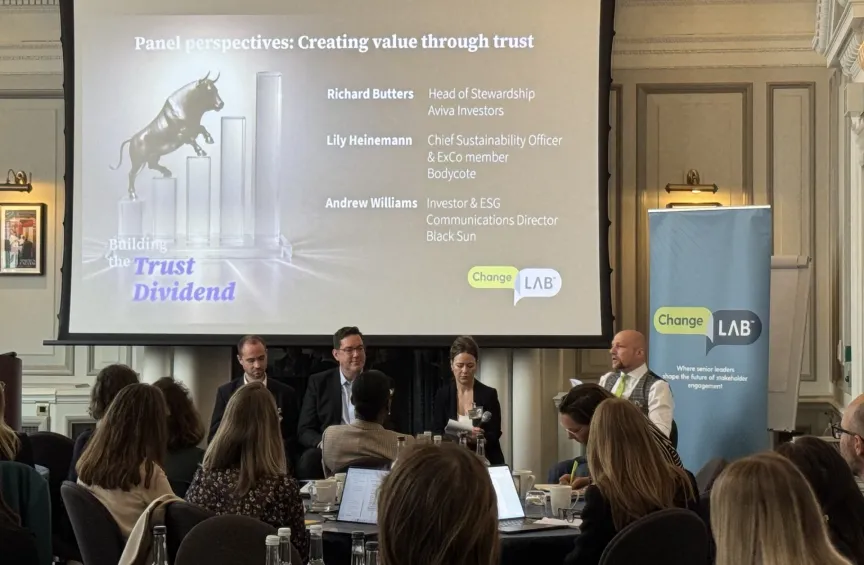
Senior leaders from AstraZeneca, BP, Burberry, GSK, Lloyds, Rio Tinto and Standard Chartered gathered in London recently for a Positive Change Group ChangeLAB event to debate one of the most pressing questions facing business today: how do you build trust through corporate reporting - and how do you know when it’s working?
The concerns in the room were consistent. Investors are raising the bar on AI disclosure — wanting to understand not just where capital is being deployed, but what it is generating, how the technology is governed and what risks boards are actively managing. The annual report itself is under pressure from two directions at once: disclosure requirements keep expanding, while the loudest demand from investors and regulators is for reports that are shorter, sharper and more decision-useful. And beneath both of those pressures sits a more fundamental question about whether reporting teams have the mandate, and the courage, to cut content that is interesting but not material.
The discussion drew on the newly launched 21st edition of Black Sun Global’s Complete 100 — one of the most comprehensive studies of FTSE 100 annual reporting available, produced in collaboration with specialist experts across the Positive Change Group, including People Made and Stratton Craig.
The Complete 100: In brief
Titled ‘Building the Trust Dividend’, the Complete 100 research assessed every FTSE 100 company against 64 questions, generating more than 6,000 data points across six principles of trust. The findings show that the organisations earning investor trust are producing the most focused, specific and transparent reports — not the longest or most polished. Clarity trumps volume. Specificity is the currency of credibility. And trust, in this context, is not a virtue. It is a financial asset: the difference between investors who back a management team and investors who fill in the gaps themselves, usually at a discount.
Inside the numbers
64%
of companies clearly lay out an investment case
51%
include specific, timebound and measurable strategic targets
70%
discuss AI initiatives but only 26% quantify the value being created
81%
openly address underperformance - a shift toward transparency
3/10
business models adequately detail how the company generates revenue
17%
reduction in the length of strategic reports compared to last year
Businesses are closing the gap between intent and evidence
Purpose statements are now near-universal across the FTSE 100. The harder task - and where meaningful separation between reporters emerges - is connecting purpose to strategy, culture and the day-to-day decisions that shape how a business operates. Boards are now expected under the UK Corporate Governance Code 2024 to demonstrate how culture has been embedded throughout the organisation, not just assessed from the top. Most are still building that capability.
Top performers: Melrose, JD Sports, M&S
58%
of reports explain how strategy delivers the company’s purpose
68%
include a KPI dedicated to people or culture
6/10
Million Pounds describe steps to prepare for Provision 29
Investors need the investment case spelled out
The Financial Reporting Council (FRC) is explicit: the primary purpose of the annual report is to help providers of capital make resource allocation decisions. A direct, focused investment case - one that distils the whole story into a coherent argument for why this business, at this point in time, deserves capital - is among the highest-value things a report can contain.
A third of FTSE 100 companies still omit one entirely. Business models remain a persistent weak point, with most failing to evidence how the company actually generates revenue rather than simply listing products and services.
Top performers: BAT, Bunzl, GSK, IG Group Holdings
64%
lay out an explicit investment case
3/10
business models adequately detail revenue generation
8/10
explicitly discuss capital allocation
Risk, performance and reward need to tell one story
An aligned report connects every part of a business to its shared goals - showing how market conditions are shaping plans, how performance drives remuneration, and how risk management is fluid and ongoing rather than a static annual exercise.
Cyber security has risen sharply up board agendas, with eight in ten reports now citing it as a principal risk. AI presents a different picture: almost half of companies reference it within emerging risks, yet fewer than one in ten treat it as a standalone principal risk - a gap that is likely to narrow quickly as disclosure expectations evolve.
61%
include explicit ties between market coverage and strategy
23
reports include a presentation of the value chain
1/10
classify AI as a standalone principal risk
Engagement only counts when it changes something
As double materiality assessments become standard, companies are expected to demonstrate not just that they engage with stakeholders, but that engagement shapes decisions.
Half of FTSE 100 boards still do not evidence stakeholder considerations in at least two key decisions during the year - a gap that sits uncomfortably alongside the governance requirements of Section 172 and the 2024 Corporate Governance Code. Acknowledgement of dissent and challenge remains rare, despite growing investor interest in how boards handle disagreement.
Top performers: Kingfisher, Shell, Rentokil
5/10
detail stakeholder considerations in at least two key board decisions
68%
detail specific programmes dedicated to progressing diversity and inclusion
55%
evidence workforce engagement on executive pay
The forward picture matters as much as the year’s performance
Stakeholders - investors in particular - read annual reports to make forward-running decisions, not to review history. Reports that help readers understand direction of travel, capital deployment and how the business is managing structural shifts command stronger credibility.
Transition planning is an emerging fault line: UK Government consultation on mandatory transition plan disclosure is underway, and half of FTSE 100 companies currently make no reference to one. AI reporting is moving fast but the credibility bar is rising - discussion of initiatives is table stakes; quantified value creation is what investors are increasingly asking for.
Top performers: Next, Rightmove, Rentokil
5/10
detail stakeholder considerations in at least two key board decisions
68%
detail specific programmes dedicated to progressing diversity and inclusion
55%
evidence workforce engagement on executive pay
Balanced, transparent, credible: scrutiny is only going to increase
AI tools are already allowing investors and analysts to interrogate annual reports faster and more thoroughly than ever before. Reports that present a selective or overly polished picture carry growing reputational risk. Four in five FTSE 100 companies now openly discuss underperformance - a genuine cultural shift toward candour. The area where credibility is most exposed, however, is AI governance: boards are building digital capability at pace, yet fewer than half of reports evidence the safeguards - policy frameworks, human oversight, testing and escalation processes - that responsible AI adoption requires.
Top performers: Compass Group, Severn Trent
81%
openly address underperformance
9/10
include digital, data, cyber or AI skills within board biographies
46%
mention AI safeguards such as policy, human oversight, escalation processes
What this means for leaders
The annual report that builds the trust dividend is specific about value creation, honest about risk, and disciplined enough to cut what does not matter to the people reading it. That requires a clear view of the audience - primarily investors making capital allocation decisions - and the conviction to prioritise their needs over internal stakeholder preferences for coverage.
The emerging challenge is AI. Boards are investing, employees are using it and strategies are being reshaped around it. Reporting needs to catch up - with quantified returns, governance frameworks and a candid account of the risks being managed. Getting ahead of that curve will have a material advantage in investor confidence.
Got any questions?
Download the full Building the Trust Dividend report. To benchmark your own annual report against the six principles of trust, or to explore how to make your reporting more focused and credible, get in touch with Black Sun Global.